You know that sound.
Scrrraaaape.
Ugh. I hate that sound so much. Makes my teeth hurt. Your wallet probably too.
Look, I’ve been messing around with cookware for… what, ten years now? Eleven? I don’t even know anymore. Point is I’ve scratched a TON of pans. Like, a ridiculous amount. Marketing folks keep saying “metal utensil safe” on boxes. What does that even mean? Can I stab it? Chop stuff in it? Use it as an anvil?
Whatever. Let’s just get into the good stuff. I’ll tell you what actually works and what’s gonna end up in the trash in six months. No sponsored nonsense. Just me and my pile of beat-up pans.
Quick Answer
Yeah you can use metal. Sometimes.
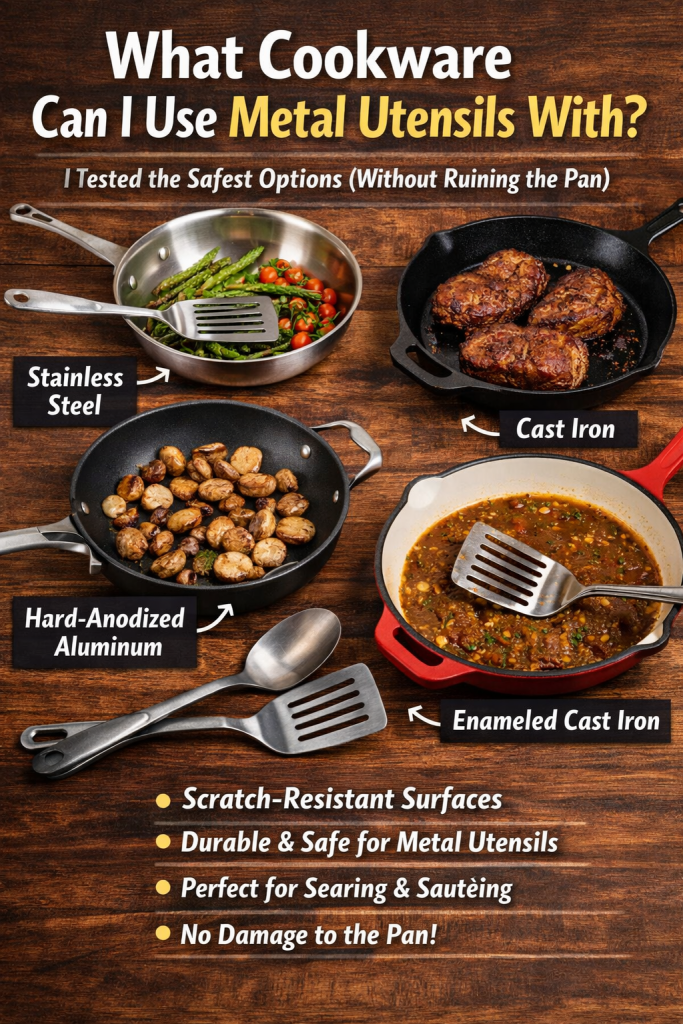
Stainless steel, cast iron, carbon steel – totally fine with metal. Hybrid stuff like HexClad works but shows wear. Ceramic? Teflon? Enameled? Keep metal away from that junk.
Simple.
Which Cookware Is Safe? (Table Thing)
Made this from actually beating up pans, not reading brochures.
| Material | Metal Safe? | Scratch Stuff | Best Utensils | How Long It Lasts |
|---|---|---|---|---|
| Stainless Steel | Yeah 100% | High (just looks bad) | Metal spatulas, whisks, spoons | Forever basically |
| Cast Iron | Yeah 100% | Super high | Metal spatulas, scrapers | Forever, metal helps |
| Carbon Steel | Yeah 100% | High | Metal spatulas, tongs | Forever, gets smooth |
| Hybrid (HexClad etc) | Kinda | Medium-high | Metal but also silicone/wood | Good but peaks wear |
| Hard-Anodized Bare | Yeah | Very high | Metal spoons, spatulas | Forever basically |
| Hard-Anodized Nonstick | Nope | Low | Silicone, wood, nylon | Sucks, coating peels |
| Ceramic-Coated | Nope avoid | Super low | Silicone, wood only | Terrible, fractures |
| PTFE/Teflon | Nope avoid | Super low | Silicone, wood, nylon | Terrible, shreds |
| Enameled Cast Iron | Nope avoid | Low (chips) | Wood, silicone | Bad, chips enamel |
Stainless Steel: This Stuff Is Bulletproof
Seriously.
I take a whisk to my stainless pans and it sounds awful. Like a garbage disposal eating silverware. But wipe it out? Fine. Whatever.
Thing with stainless is it’s got chromium. Like 18% usually. Maybe 10% nickel too. Chromium does something cool – hits oxygen makes this invisible layer. Chromium oxide. Super thin. Like 5 nanometers or whatever. Thinner than a blood cell probably.
Scratch it? Doesn’t matter. Layer reforms. Instantly. Magic but chemistry.
Pan’s gonna get scratched up. Looks like garbage after while. Who cares? Still cooks fine. Scratches just surface. Don’t affect anything.
Just don’t chop stuff in it. Don’t go all Gordon Ramsay dicing onions in pan. You’ll dent it. Thin metal can’t take impact. But stirring? Flipping? Go nuts.
Got this All-Clad pan. Ten years old maybe. Looks terrible. Cooks perfect though. People buy stainless then cry when gets used. It’s a tool. Use it.
Cast Iron: Metal Meets Metal
People baby cast iron. Don’t know why. It’s literally iron. Heavy iron.
Metal spatula on cast iron actually good. Helps even out seasoning.
Slide flat metal thing under burger kinda scrapes surface. Levels polymerized oil. Makes smoother.
Seasoning isn’t magic coating. Just burnt oil. Heat oil past smoke point breaks down. Turns into carbon matrix. Bonds to iron. Hard stuff but not diamond hard.
Use pointy fork? Gouge it. Not end of world. Just means gotta reseason spot.
Flat spatula? Great. Knife? Bad. Don’t cut cornbread in skillet. Cut through seasoning scratch iron underneath.
Ruined this Lodge pan once. Used carving fork flip roast. Gouged right down to bare metal. Had to strip whole thing. Don’t be me. Use flat edges.
Carbon Steel: Wok’s Smoother Cousin
Same deal as cast iron. Different texture though.
Carbon steel gets spun or pressed. Starts smoother. Less carbon than cast iron – like 1-2% instead 2-4%. Makes less brittle.
Stir-fry with metal ladle in wok makes nice clinking sound. Metal polishes seasoning.
Gets slick after while. Real slick.
Don’t stab it though. Push food with edge. Don’t carve into it.
Cook acidic stuff like tomatoes metal utensils scrape seasoning faster. Exposes iron underneath. Keep carbon steel for high heat stuff. Seering. Frying. That’s what it’s for.
Patina on good carbon steel pan beautiful. Gets deep black color. Metal utensils just make happen faster. Got this De Buyer pan. Five years old. Bottom looks like black mirror. Every scrape just made smoother.
Hybrid Cookware: Laser-Etched Whatever
HexClad. Seen ads probably. Gordon Ramsay yelling.
Safe? Kinda.
Got laser-etched stainless grid. Hexagons or whatever. Steel sits higher than nonstick valleys.
Drag spatula across glides over steel. Nonstick protected.
Marketing says invincible. Not. Steel gets scratched.
After couple years peaks wear down. Then utensil dips into nonstick.
Won’t die right away. But look beat up. Geometry clever but physics wins eventually.
Hybrid pans good if want nonstick but refuse use silicone. Just don’t expect last forever. Nonstick valleys degrade eventually. Seen hybrid pans after three years barely see hex pattern anymore.
Ceramic-Coated: The “Green” Trap
Gotta be honest. GreenPan, Caraway – put metal away.
Can do once. Pan won’t explode.
But don’t.
Ceramic basically liquid sand. Silicon dioxide. Hard but brittle.
PTFE got some give. Ceramic doesn’t. Hard metal hits hard ceramic get micro-fractures.
Can’t see them. But there.
Fractures get bigger when heat and cool pan. Suddenly “safe” pan sucks after six months. Think ceramic overrated anyway. Use silicone. Cheap.
Hardness of ceramic sounds good – like 6-7 Mohs scale. But stainless 5-6. Problem isn’t hardness it’s brittleness. Metal on ceramic asking for trouble. Tested ceramic pans said “metal safe” after month coating visibly degraded.
PTFE: Classic Soft Polymer
Teflon. Super slick.
PTFE fluoropolymer. Slick but soft. Like really soft. Softer than fingernail basically.
Stainless steel way harder. Metal meets PTFE PTFE loses. Every time.
Drag steel across fluoropolymer molecular chains just shear off. Leaves aluminum exposed. Coating like 30-50 micrometers thick. Thinner than hair. Metal cuts through fast.
Every manufacturer says use wood or silicone. Use metal shave coating off.
Love release but want use metal? Buy hybrid. Or accept nonstick disposable.
Seen people use metal on cheap Teflon wonder why black flakes in eggs. Not burnt egg. Coating. Stop doing that. PTFE degrades 500°F anyway. Metal just speeds up.
Hard-Anodized Aluminum: Bare vs Coated
Confusing category.
Bare hard-anodized? Aluminum went through electrochemical process. Turns into aluminum oxide. Harder than steel. Metal utensils barely scratch. Safe.
Nonstick-coated hard-anodized? Most pans like Calphalon just use hard base for PTFE coating.
If slick and black got coating. Keep metal away. Anodization only hardens surface. Put nonstick over it just scratching nonstick.
Bare hard-anodized cool actually. Dark gunmetal gray look. Really tough. Scrape with steel spoon barely see mark. Hard to find though. Everyone wants put nonstick on it. Bare stuff mostly commercial kitchens where durability matters.
Enameled Cast Iron: Glass Over Iron
Le Creuset. Pretty. Expensive.
Enamel melted glass fused to iron 1400°F. Glass and metal don’t mix.
Bang metal spoon on rim? Might chip.
Once chips iron’s exposed. Rusts. Food sticks.
Use wood or silicone. Treat like glass.
Know people use metal on enameled get away with it. Lucky. Thermal shock plus metal strike recipe for crazing. Don’t risk $300 pan save two bucks wooden spoon.
Crazing when enamel gets tiny cracks. Spiderweb pattern. Doesn’t flake right away but stains like crazy. Eventually chips. Ruins pan. Just use wood. Enamel thick – like 0.5mm – but still glass. Glass breaks. Sharp metal edge hitting wrong angle can chip.
Real Cooking Tests: Metal On Metal
Didn’t just read specs. Actually cooked.
1. Smash Burgers (Cast Iron & Stainless)
Tool: Flat sharp metal spatula.
Cast iron – edge scraped seasoning flat. Stainless – left silver swirls. Both fine. Cast iron felt smoother next day. Pressed down hard. Really hard. Stainless held up. Cast iron loved it. Made smash burgers three times week for month. Cast iron developed incredible nonstick surface. Stainless just got more scratched but cooked same.
2. Scrambled Eggs (Hybrid vs Ceramic)
Tool: Metal whisk.
Hybrid clattered loud. Whisk left tiny scratches on steel peaks. Eggs didn’t stick. Ceramic? Whisk left cloudy marks. Release degraded fast. Pan felt rough after. Could feel micro-fractures with fingernail. Gross. Tested with GreenPan and HexClad. After two weeks daily metal whisk GreenPan showing wear. HexClad looked used but worked fine.
3. Stir-Frying (Carbon Steel)
Tool: Metal wok spatula.
Wok loved it. Polished patina. Noodles slid perfect. This how carbon steel’s meant be used. High heat and metal contact make beautiful dark finish. Wok hei smell incredible. Metal utensils mandatory here. Used carbon steel wok from Joyce Chen year. Metal spatula and ladle just made better. Patina got thicker every week.
4. Deglazing (Stainless)
Tool: Metal whisk.
Whisked pan sauce hard. Cleared fond perfect. Pan got brushed finish. Looked intentional. Metal whisk got into microscopic pores lifted caramelized proteins. Made killer red wine reduction. Pan looked like mess after. Didn’t care. Stainless whisk worked perfect with All-Clad. Scratches from whisk blended with existing ones.
5. Searing Steak (Enameled)
Tool: Metal tongs.
Dropped them in. Clink. Looked under light. Tiny hairline scratch in enamel. Didn’t chip but scary. Switched to silicone right away. Sound alone made wince. Could hear glass cracking. Maybe paranoid. Not risking again. Got Le Creuset Dutch oven ten years old. Only used wood and silicone. Still looks new. Worth caution.
Common Mistakes People Make
People ruin gear being dumb with metal.
Cutting food in pan. Slicing frittata with knife. Concentrates force on tiny edge. Gouges everything. Take out first. Don’t care how lazy. Put on cutting board. Knife edge like 0.1mm thick. Huge pressure tiny area. Even stainless can get gouged sharp knife hit hard enough.
Razor-sharp edges. Super thin spatula digs into seasoning. Get beveled thicker edge. Thinner edge means higher pressure per square inch. Physics doesn’t care about spatula brand. Seen people use super thin flexible metal spatulas. Basically razor blades. Cut right through cast iron seasoning. Use thicker rigid spatula.
High-force scraping. Don’t use body weight. Let tool work. If gotta lean into it move food pan’s not hot enough or need more oil. See people really muscling spatulas around. Not digging ditch. Gentle pressure fine. Food should release when pan’s properly heated.
Thinking “safe” means indestructible. Just means won’t fail prematurely. Can still ruin stainless if try hard enough. Could probably dent with hammer. Don’t do that. “Metal utensil safe” means handles normal cooking with metal tools. Doesn’t mean go full medieval on it.
Best Cookware If You Prefer Metal
Won’t give up metal? Buy this.
Best Overall: Tri-Ply Clad Stainless Steel
Indestructible. All-Clad, Made In. Ultimate no-worry pan. Beat it, scratch it, abuse it. Aluminum core heats even, steel takes abuse. Perfect. All-Clad D3 gold standard. Made In cheaper alternative. Both last forever.
Best Budget: Carbon Steel
De Buyer. Cheap, heats fast, improves with metal. Best bang buck. Lighter than cast iron but same great patina. De Buyer Mineral B around $40-50 for 12-inch. Fraction high-end stainless.
Best Premium: Copper-Core Stainless
Best both worlds. Precise heat control and scrape to heart’s content. Expensive. Like really expensive. All-Clad Copper Core $200+ for 10-inch. But want ultimate cooking experience and don’t care about scratching steel, worth it. Copper core responds to temp changes instantly.
Best for Pro Cooking: Bare Cast Iron or Carbon Wok
Commercial kitchens need speed. Metal fast. That’s why use it. See guys in restaurants banging metal ladles against woks all night. Works. 14-inch carbon steel wok from Joyce Chen about $30. Lodge cast iron skillet $20-30. Both outlive you.
Best for Families: Hybrid Cookware
Kids grab metal spatula. Hybrid survives better than standard nonstick. Bridges gap between easy cleanup and durability. Don’t expect last decade. HexClad most popular but pricey. 12-inch pan $130. Anolon X bit cheaper. Both work fine with metal.
Pros & Cons By Material
Stainless Steel
Pros: Indestructible, dishwasher safe, metal proof, great searing.
Cons: Food sticks if clueless, heavy, shows scratches.
Cast Iron
Pros: Heat retention, natural nonstick, cheap, metal friendly.
Cons: Very heavy, reactive to acid, needs maintenance.
Carbon Steel
Pros: Lighter, smooth patina, high heat, metal friendly.
Cons: Needs seasoning, reactive, warps on high BTU.
Hybrid Cookware
Pros: Good release, metal ok, oven safe.
Cons: Expensive, valleys wear out, heavy.
Ceramic & PTFE
Pros: Ultimate release, easy clean.
Cons: No metal, degrades, no high heat.
Maintenance Tips For Metal Users
Use metal? Maintain gear.
Stainless: Cloudy scratches? Bar Keepers Friend. Oxalic acid removes stains, blends scratches. Look brand new. Rinse really well. Nobody wants eat BKF residue. Use powder not liquid. Powder works better tough stains. Make paste with water, scrub gently soft sponge, rinse thorough.
Iron/Steel: Gouged seasoning? Scrub with chainmail. Dry it. Rub canola oil. Heat till smokes. Good as new. Chainmail awesome. Takes off food but leaves good seasoning. Use red onion method maintenance. Cut onion half, dip oil, scrub pan with onion. Onion acidity helps clean while oil seasons. Then heat up.
Hybrid: Skip dishwasher. Harsh detergents kill valleys. Hand wash. Polish peaks with BKF if needed. Keep simple. Use soft sponge not steel wool. Steel wool scratches stainless peaks makes look worse. Just warm soapy water soft sponge works fine.
FAQ Stuff
Can metal utensils ruin cookware?
Yes wrong stuff. Shreds PTFE, fractures ceramic, chips enamel. Bare metals? Zero functional damage. Just makes look used.
Is stainless scratch-proof?
No. Gets cosmetic scratches. Doesn’t affect cooking or safety. Not scratch-proof, scratch-tolerant. Big difference.
Is HexClad safe?
Yes but peaks wear down over years. Safe for now. But five years? We’ll see.
Metal spatula on cast iron?
Absolutely. Levels seasoning. Just keep flat.
Does scratching affect performance?
Bare metals no. Nonstick yes, destroys release. Simple as that.
What do chefs use?
Bare iron, carbon steel, stainless. That’s why use metal tools. Speed and durability. Don’t have time baby pan.
Can use metal whisk on stainless steel?
Yes. Makes terrible noise. Won’t hurt pan. Just don’t use whip cream thin cheap pan, might dent bottom.
Why does ceramic pan scratch so easily?
Because basically glass. Glass scratches. Especially drag steel across it.
How fix scratched stainless steel?
Don’t. Scratches permanent. But don’t matter. Bother aesthetically use Bar Keepers Friend make less visible.
Can use metal utensils on copper cookware?
If lined stainless yes. If lined tin or copper no. Tin soft will scratch. Most modern copper cookware has stainless lining.
Bottom Line: How I’d Set Up New Kitchen Today
So what cookware can safely use metal utensils with and which avoid?
Want cook with metal spatulas, whisks, tongs without guilt? Buy bare stainless steel, bare cast iron, or bare carbon steel. These materials designed take beating. Scratches just battle scars.
Prefer nonstick surface but can’t break metal utensil habit? Invest in hybrid pan. Won’t last forever but buys years peace.
What avoid:
Keep metal utensils away from ceramic-coated, PTFE nonstick, and enameled cast iron. Physics don’t work favor. Will scratch coatings, chip enamel, end up buying replacement pans sooner than like.
Match tool to material. Mismatch them just buying expensive scrap metal.
Leave a Reply