I used to own fourteen pieces of cookware. Fourteen. A twelve-piece “starter set” from a wedding gift, a cast iron skillet my mom basically forced on me, and a wok bought during a stir-fry phase that lasted maybe six weeks before I moved on to something else.
Four of them got used regularly. The other ten sat nested in a lower cabinet, getting scratched every single time I dug past them for the one pan I actually wanted. Sound familiar?
It took years – and a couple of moves, which have a way of forcing you to confront exactly how much stuff you’re dragging around for no reason — to figure out which pieces earned a permanent spot on the stove and which ones were just cabinet clutter because a marketing team convinced me a “complete” set meant a complete kitchen.
It doesn’t. Not even close.
This guide is the version of this lesson I wish someone had given me a decade ago. No affiliate hype, no lists bloated with “must-haves,” no twelve items when four would suffice. Just what’s actually used, what isn’t, and why.
If you’ve ever wondered which pots and pans you need before buying, here’s the honest answer: fewer than you think. This is a practical guide to buying cookware based on real-life experience—burnt sauces, dented lids, the whole mess—not on a showroom display. Basically, it’s the list of essential cookware I’d give to a friend moving into their first apartment, just without the sales pitch.
Quick Answer: The Cookware Most Households Actually Need
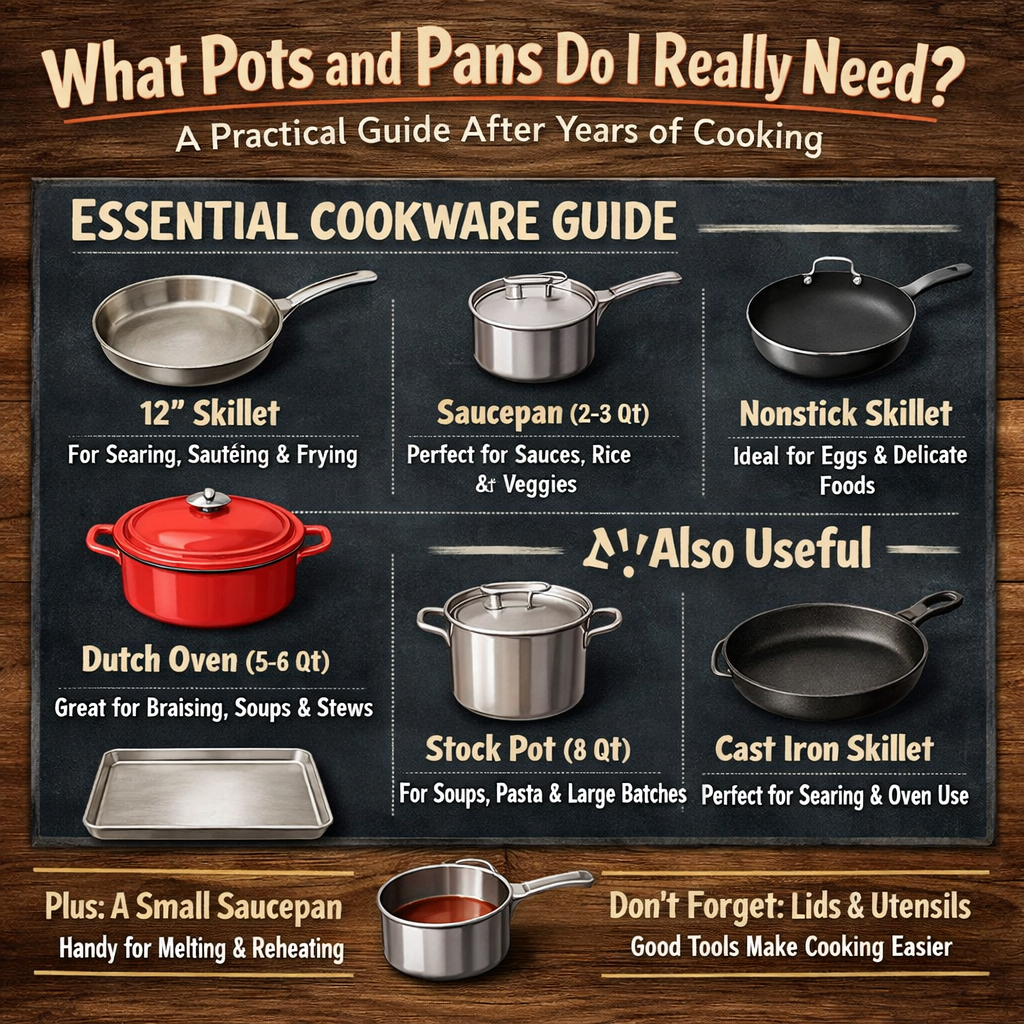
Short version first, reasoning after. Most home cooks can run a full kitchen — scrambled eggs on a Tuesday, a full roast on Sunday — with these:
- 10 or 12-inch frying pan (nonstick or stainless)
- 2 to 3-quart saucepan
- 4 to 5-quart saucepan or Dutch oven
- 6 to 8-quart stockpot
- Large sauté pan with lid (3 to 4 quarts)
- Cast iron skillet (10 or 12-inch)
- One or two sheet pans
Seven pieces. That’s genuinely it. Anything past this list is either a specialty tool for a cuisine you cook a lot, or something you’ll touch twice a year and could just as easily borrow from a neighbor.
Kitchen cookware checklist:
- [ ] Frying pan
- [ ] Small saucepan
- [ ] Large saucepan or Dutch oven
- [ ] Stockpot
- [ ] Sauté pan
- [ ] Cast iron skillet
- [ ] Sheet pan(s)
Why Most People Buy Too Many Pots and Pans
Cookware sets exist because a set is much easier to sell than seven separate purchases, each justified on its own. Twelve pieces stacked on a stove in a glossy photo simply convey the feeling of a complete kitchen. To be honest, that’s a good selling point. And that’s exactly how you end up with three pots of nearly identical sizes and a sauceboat that you might use twice in your life.
A lot of “must-have pots and pans” lists floating around online are really just manufacturer inventory sheets dressed up as advice. I’ve noticed this a hundred times. True cookware essentials are the handful of pieces that show up in your sink every single week — not the ones that photograph nicely.
A few patterns I keep seeing, in my own kitchen and everyone else’s:
Duplicate sizes sneak in. Most twelve-piece sets pack in two saucepans close enough in volume that you’ll just grab whichever one’s cleaner. That’s not two useful tools. That’s one tool and one dead weight taking up a shelf.
Small pieces go unused. The 1-quart butter warmer. The tiny 6-inch fry pan. Cute in the box, ignored the second you own an actual stove and actual hunger.
Specialty pans assume a cooking style you might not have. A dedicated omelet pan, a fish poacher, a paella pan — genuinely excellent if that’s your thing. Most people buy them aspirationally, use them once, and forget they exist.
Fewer, better pieces just plain perform better. I’d rather cook with four pans I trust completely than twelve I’m lukewarm on. Good cookware — even heat, decent handles, lids that actually seal — costs real money, and spreading a budget across twelve mediocre pieces almost always loses out to concentrating it on the ones you’ll actually reach for.
None of this makes sets a scam, to be clear. Some are genuinely good value, if the pieces line up with what you cook. Just buy for your habits. Not the marketing photo.
The Essential Pots and Pans
10 to 12-Inch Frying Pan
The workhorse. Eggs, sautéed vegetables, seared chicken breasts, pan sauces, last night’s leftovers — this pan touches food almost every day, full stop.
Ideal size: 10-inch for one or two people. 12-inch if you’re cooking for a family or just want room so food isn’t crammed and steaming instead of browning.
Best material: Nonstick for eggs and delicate fish — no argument there. Stainless steel if you want better searing and don’t mind a bit more cleanup and a little technique. Going stainless? Look for fully-clad (also called tri-ply) construction — that’s cladding, a layer of aluminum or copper sandwiched between steel, which keeps heat even instead of scorching-hot in the center and lukewarm at the edges. Flared rims help too, more than people expect, when you’re pouring off fat or sauce.
Essential or optional: Essential. No debate here, honestly.
Saucepan (2 to 3 Quart)
Rice, oatmeal, sauces, soup for one, a couple of boiled eggs, melted butter for a recipe. Small daily jobs that don’t need a huge pot hogging a burner.
Ideal size: 2 to 3 quarts covers most single-serving to small-batch cooking.
Best material: Stainless steel with an aluminum or copper core for even heat. Skip thin, cheap stainless — it scorches milk and sauces almost on principle. If you make a lot of sauces from scratch, a saucier is worth considering: same job, but rounded, sloped sides instead of a flat bottom and hard corner, which makes whisking into the corners way easier.
Essential or optional: Essential.
Large Saucepan or Dutch Oven (4 to 6 Quart)
This is where a lot of the actual cooking happens — pasta for a family, chili, braises, soup that needs to feed more than two people.
Ideal size: 4 to 6 quarts.
Best material: Enameled cast iron if you want one pot that goes stovetop to oven and holds heat beautifully for braises. Stainless steel if you’d rather have something lighter and cheaper that still handles the same daily jobs.
Essential or optional: Essential, and honestly the piece I’d spend more on if budget allows. This one gets heavy, frequent, unglamorous use.
Stockpot (6 to 8 Quart)
Pasta water, stock, big batches of soup, corn on the cob, occasional canning. Not a daily pan for most people — but when you need it, nothing else does the job.
Ideal size: 6 to 8 quarts for most households. Go up to 12 quarts if you cook for a crowd often, or can a lot of stuff.
Best material: Stainless steel. No need for anything fancier — this pot mostly boils water and simmers. It’s not doing any searing.
Essential or optional: Essential if you cook pasta regularly or make stock. Skippable if you genuinely never do either — some people just don’t.
Sauté Pan (3 to 4 Quart, With Lid)
Different animal than a frying pan — straight sides, more volume, comes with a lid. Great for anything that starts with a sear and finishes in liquid: braised chicken thighs, risotto, pan sauces that need more room than a frying pan gives you.
Ideal size: 3 to 4 quarts.
Best material: Stainless steel or tri-ply for good browning, with a fitted lid for the simmer stage.
Essential or optional: Genuinely useful, but it overlaps with what a Dutch oven and a large frying pan can already do together. I’d call this “highly recommended” rather than strictly essential if the budget’s tight.
Cast Iron Skillet
Steaks, cornbread, anything wanting a hard sear or a trip from stovetop to oven. Once it’s seasoned, it’s close to nonstick, and it basically lasts forever if you don’t neglect it — mine’s older than some of my friendships.
Ideal size: 10 or 12-inch.
Best material: Just cast iron. That’s kind of the whole point of this one.
Essential or optional: Essential for anyone who sears meat, bakes cornbread, or wants an oven-safe pan that can take real heat. Skippable if you’re strictly a nonstick-eggs-and-vegetables cook.
Sheet Pans
Roasted vegetables, sheet-pan dinners, cookies, reheated pizza, toasted nuts. Not technically “pots and pans,” I know, but I’d rank these above half the specialty items people buy instead.
Ideal size: Half-sheet (18×13 inches) fits most home ovens.
Best material: Aluminum, heavy gauge so it doesn’t warp the first time it hits a hot oven.
Essential or optional: Recommended, arguably essential. Own at least two so one can cool while the other goes back in.
Wok
Genuinely great if you stir-fry often and have a burner that puts out real heat. On a standard Western stove, though, a wok tends to underperform — it’s built for the high, concentrated heat of a dedicated wok burner, which most home kitchens just don’t have.
Essential or optional: Optional. Buy it because you actually cook that style a lot, not because it looked cool in a video.
Grill Pan
Nice for indoor grill marks in winter. Realistically? A hot cast iron skillet or a broiler does the same job for most people, minus the awkward storage shape that never fits anywhere.
Essential or optional: Optional — one of the first things I’d cut if a kitchen is small.
Roasting Pan and Braiser (Occasional Use)
A 14 to 16-inch roasting pan with a rack earns its keep exactly twice a year for most people — holiday turkey, maybe a big roast. A braiser, the wide shallow cousin of a Dutch oven, is nice for one-pan chicken thigh dinners, but a sauté pan or Dutch oven does the same job in a pinch.
Essential or optional: Optional. Worth owning if you host often. Otherwise, borrow one or skip it entirely.
What Material Should You Choose?
| Material | Durability | Maintenance | Cooking Performance | Best For |
|---|---|---|---|---|
| Stainless Steel | Very high, lasts decades | Low, dishwasher safe usually | Excellent searing, not naturally nonstick | Everyday cooking, sauces, browning |
| Nonstick | Moderate, coating degrades over years | Low, but needs gentle utensils and lower heat | Great for eggs, fish, delicate foods | Breakfast foods, quick cleanup meals |
| Ceramic-Coated | Moderate, coating can wear faster than traditional nonstick | Low, hand wash recommended | Good nonstick when new, fades over time | Health-conscious cooks avoiding PTFE |
| Cast Iron | Extremely high, can outlive you | Higher, needs seasoning and drying | Excellent heat retention, great sear | Steaks, cornbread, oven-to-stove dishes |
| Carbon Steel | High | Similar to cast iron, needs seasoning | Lighter than cast iron, heats faster | Stir-fry, high-heat searing |
| Copper | High if cared for | High, needs polishing, often relined | Best heat responsiveness, precise control | Sauces, candy-making, advanced technique |
A few honest notes, from actually living with all of these:
Stainless steel is what I reach for most often—once you’ve learned how to preheat it properly and use enough fat. It isn’t naturally nonstick, and yes, food will stick if the pan isn’t hot enough. That’s a matter of technique, not a flaw—it took me an embarrassingly long time to accept that.
Nonstick coatings make cooking eggs and fish much easier, especially at first. Conventional coatings use PTFE—and that’s exactly what most people mean when they say “Teflon.” Ceramic-coated pans are marketed as a PTFE-free alternative for anyone who’d rather avoid it. Either way—coatings wear out after a few years of regular use. Think of a nonstick pan as a pan you’ll eventually replace. Not as a product that will last a lifetime.
Cast iron rewards patience. It takes longer to heat up, is heavy, and needs to be dried and oiled – but my cast-iron skillet has outlasted every nonstick pan I’ve ever owned by a wide margin.
Copper is beautiful and reacts incredibly quickly, but it’s expensive and high-maintenance. Unless you’re doing precision work—such as making confections or delicate sauces—it’s more of a luxury than a necessity. I own just one piece. I use it maybe six times a year. For me, it’s worth it. For you, maybe not.
Cookware Set vs Individual Pieces: Which Makes the Best Cookware Setup?
Sets are cheaper per piece. There’s no question about that. If you really need eight or more pieces and the sizes actually match your cooking habits, you can save a significant amount of money with a set.
The catch: Sets are based on the idea of a “complete kitchen” and not on your actual habits. In the end, you’ll pay for pieces you’ll never use, just to get the two or three you actually wanted.
Buying individual pans costs more per pan at first, but you choose exactly the sizes and materials that suit your cooking style, and you can spread the cost out over months instead of spending everything at once.
What I’d actually recommend: starting from zero on a tight budget, a well-reviewed 8 to 10-piece set from a reputable brand is a reasonable base. Then supplement with a good cast iron skillet and a real Dutch oven later — those two are usually the weak points in budget sets anyway.
Already have a few pieces, or some cash to spend deliberately? Buy individually. You’ll end up with a kitchen that matches how you actually cook, not how a catalog photographer arranged twelve pans on a stovetop for a photo shoot.
Recommended Cookware Setups by User
Beginners: The short version of any beginner cookware guide for pots and pans for beginners — frying pan (nonstick), 3-quart saucepan, stockpot, sheet pan. Learn on these four before adding anything else. You genuinely don’t need more yet.
First Apartment: The classic cookware for first apartment situation — small budget, small storage, small stove that may or may not actually work properly. Same as beginners, plus a small Dutch oven if the budget stretches; it pulls double duty as a soup pot and a braiser when cabinet space is tight. This is also the core list I’d suggest for anyone shopping cookware for new home setups, starting completely from zero.
College Students: Frying pan and one mid-size pot. That’s it. Genuinely covers 90% of dorm and small-kitchen cooking. Add a rice cooker before you add more cookware — it’ll get more use than a second pan ever would.
Couples: Frying pan, 3-quart saucepan, 5-quart Dutch oven, sheet pan. Enough capacity for two without oversized pots that never get filled and just take up space.
Families: Large frying pan, stockpot, sauté pan, Dutch oven, two sheet pans. Volume matters more here — undersized cookware for a family of four just means more batches, more dishes, more standing around waiting.
Serious Home Cooks: Everything on the essentials list, plus a carbon steel pan for high-heat work and a copper saucepan if sauce-making is a hobby and not just a chore.
Minimalist Kitchens: If minimalist cookware is the actual goal, this is as lean as it gets — one versatile frying pan, one Dutch oven that can sear, braise, boil, and bake. Two pieces. Genuinely functional, no compromise really required.
Budget-Conscious Buyers: Stainless frying pan and saucepan bought individually from a mid-tier brand, plus a basic cast iron skillet. Cast iron is one of the rare spots in cookware where cheap and excellent actually overlap.
Recommended Budget Levels
Under $150: A basic stainless frying pan, a saucepan, and a cast iron skillet. Cast iron is genuinely the best value-per-dollar item in all of cookware — a $25 skillet performs shockingly close to a $200 one once it’s seasoned.
$150–$300: Adds a proper stockpot, a Dutch oven (likely uncoated cast iron rather than enameled at this price point), and better nonstick for eggs.
$300–$600: Here’s where tri-ply stainless, enameled Dutch ovens from reputable brands, and heavier-gauge sheet pans enter the picture. Heat distribution and longevity both step up noticeably.
Premium ($600+): Full tri-ply or five-ply stainless sets, premium enameled cast iron, maybe some copper. The gains here are real but incremental — you’re paying for polish, warranty length, and marginal heat control. Not a fundamentally different cooking experience, whatever the marketing implies.
What actually changes as budget climbs isn’t whether food gets cooked properly. It’s evenness of heat, warranty length, handle comfort, and how the pan still looks after five years of Tuesday-night dinners.
Cooktop Compatibility
| Cooktop Type | Works Well With | Avoid |
|---|---|---|
| Gas | Almost anything — stainless, cast iron, carbon steel, copper | Very thin cookware that warps under direct flame |
| Electric Coil | Flat-bottomed stainless, cast iron | Warped or thin pans that don’t sit flush |
| Glass-Top | Stainless steel, enameled cast iron, flat-bottomed nonstick | Rough, unfinished cast iron that can scratch the surface |
| Induction | Magnetic stainless steel, cast iron, carbon steel | Aluminum, copper, or ceramic without a magnetic base plate |
Not sure if a pan works on induction? Hold a magnet to the bottom. Sticks, it works. Doesn’t, it won’t. Takes ten seconds and saves an argument at checkout.
Common Buying Mistakes
Buying an oversized set “to be safe.” More pieces mean more storage and more money spent on stuff that’ll sit untouched. Buy for the cooking you actually do, not the cooking you imagine doing.
Choosing material based on looks instead of use. A gorgeous copper set is wasted on someone who mostly wants to fry eggs and boil pasta. Gorgeous doesn’t season your food.
Ignoring lid quality. A loose-fitting or plastic-handled lid that can’t go in the oven limits what a pot can actually do. Check the lid as carefully as the pan itself — people never do, and it shows later.
Focusing only on nonstick. Great for eggs, bad for searing. A kitchen built entirely around nonstick pans just can’t do half of what stainless or cast iron can, no matter how good the coating is.
Buying based on celebrity or influencer endorsement. A pretty color and a famous name tell you nothing about heat distribution or whether the handle rivets hold up after two years of actual use.
My Recommended Starter Kitchen
| Piece | Size | Material | Why I Chose It |
|---|---|---|---|
| Frying pan | 10–12 inch | Stainless steel | Versatile searing and everyday cooking |
| Saucepan | 2–3 quart | Stainless steel | Daily small-batch tasks |
| Dutch oven | 5–6 quart | Enameled cast iron | Braising, soups, stovetop-to-oven flexibility |
| Stockpot | 6–8 quart | Stainless steel | Pasta, stock, big-batch cooking |
| Cast iron skillet | 10–12 inch | Cast iron | Searing, oven-safe, near-permanent lifespan |
| Sheet pan | Half-sheet | Aluminum | Roasting, baking, reheating |
Six pieces. That’s the kitchen I’d build if starting over today, and honestly it’s close to what I actually use week to week right now.
Comparison Table
| Cookware Piece | Recommended Size | Best Material | Essential or Optional | Typical Uses |
|---|---|---|---|---|
| Frying pan | 10–12 inch | Stainless or nonstick | Essential | Eggs, sautéing, searing |
| Small saucepan | 2–3 quart | Stainless steel | Essential | Rice, sauces, reheating |
| Dutch oven | 5–6 quart | Enameled cast iron | Essential | Braises, soups, baking bread |
| Stockpot | 6–8 quart | Stainless steel | Essential | Pasta, stock, large batches |
| Sauté pan | 3–4 quart | Stainless steel | Recommended | Braising, pan sauces |
| Cast iron skillet | 10–12 inch | Cast iron | Essential | Searing, oven dishes |
| Sheet pan | Half-sheet | Aluminum | Recommended | Roasting, baking |
| Wok | 12–14 inch | Carbon steel | Optional | Stir-fry |
| Grill pan | 10–11 inch | Cast iron | Optional | Indoor grilling |
FAQ
What pots and pans does every kitchen need? A frying pan, a small saucepan, a large pot (Dutch oven or stockpot), and a sheet pan. That combo covers the vast majority of daily cooking, no matter who’s doing it.
Is a cookware set worth buying? Sometimes — if the sizes actually match your habits and you’re starting from zero. Otherwise individual pieces tend to fit real cooking better, and you’re not paying for filler.
How many pots and pans should I own? This is basically another way of asking “how many pots and pans do I need,” and the honest answer is: most households function well with six to eight pieces. Past that, it’s usually clutter, not better cooking.
What cookware should I buy first? A frying pan, then a mid-size saucepan. Those two alone cover a surprising share of everyday cooking. Everything else can follow once you actually know how you use a kitchen — not before.
Which pan gets used the most? The frying pan, by a wide margin. Whatever mid-size pot handles pasta and soup usually comes in second, not particularly close.
What cookware do chefs recommend? Most professional cooks I’ve talked to lean on stainless steel and cast iron for the durability and searing, keeping nonstick specifically for eggs and delicate fish. Not much mystery there.
Is stainless steel better than nonstick? Neither wins outright — stainless sears and browns better, nonstick is easier for delicate foods. Most kitchens genuinely benefit from having both around.
Which cookware lasts the longest? Cast iron and stainless steel, easily. Both can last decades, sometimes generations, with basic care. Nonstick coatings wear down after a few years no matter what you paid for them.
These six to eight pieces are, in my experience, the real cookware essentials for home cooks — not the twelve-piece box, not the aspirational wok gathering dust. Just the stuff that gets dirty every week and gets washed and used again the next day.
Final Verdict
If I were to set up a kitchen from scratch today, these would be the only pots and pans I’d buy: a stainless steel skillet, a small pot, a Dutch oven, a soup pot, a cast-iron skillet, and a baking sheet. Six pieces. Everything else—the wok, the grill pan, the special saucepan—would only be added once I actually realize I want them. Not before, and certainly not because a set has led me to believe I need them.
Bottom Line
What you actually need is less than what every 12-piece set tries to sell you: a frying pan, a saucepan, a large pot, and a cast-iron skillet cover almost everything you’ll need in a home kitchen day in and day out. What you can safely leave out is almost everything marketed as an “essential extra” – the grill pan, the extra pot in a barely different size, the specialty pans you use twice a year and then forget you even own. Buy fewer items. Buy them in a quality you truly trust. And let your actual cooking habits—not a marketing photo, not a wedding registry—decide what deserves a permanent spot in your cupboard.
Leave a Reply