If you’ve bought kitchenware in recent years, you’ve probably run into the same problem I have. Some manufacturers loudly proclaim, “PFOA-free.” Others boast, “PFAS-free.” Still others simply write “with a hard anodized coating” and leave it at that, as if that single phrase were enough to make everything clear. But it isn’t. It’s frustrating, isn’t it? It was precisely this confusion that prompted me to embark on this research.
So I delved deeper into the subject: manufacturer data, the materials science behind anodizing, the history of fluoropolymer regulations—there’s much more to it than I actually expected. And the thing is, this confusion isn’t really about complex chemistry. The issue is that two different technologies are lumped together under a single marketing term: metal processing and the coating applied to it. Two different things, one confusing package.
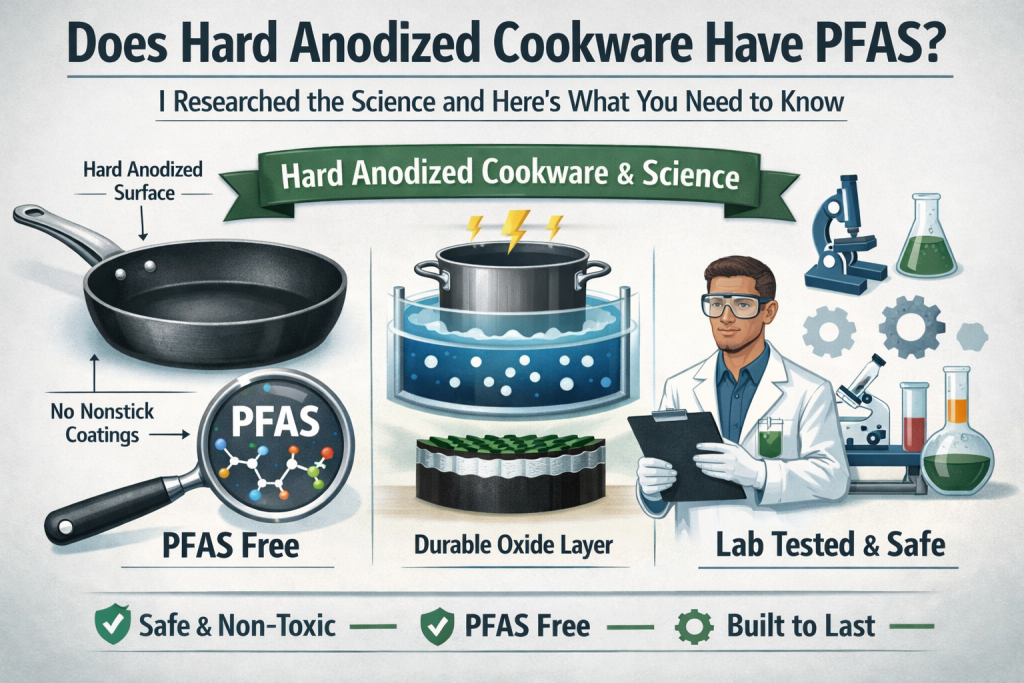
Hard anodizing and nonstick coatings are not the same thing, period. A pan can be hard anodized and never even come close to PTFE in its entire lifetime. However, a hard-anodized pan can also have a PTFE-based nonstick coating on the metal. Which type you’re holding in your hand determines whether your pan contains PFAS. It’s not the words “hard-anodized” printed in bold letters on the packaging.
This article provides an overview of the scientific background, the technical terms, the specific claims made by certain brands, a state law that now mandates some of this information—whether the brands like it or not—as well as a clear answer to the question in the title.
Quick Answer
Does hard anodized cookware have PFAS? Short answer: Not by nature. Anodizing is an electrochemical treatment that thickens and hardens aluminum’s natural oxide layer. That’s really all that happens. Neither fluoropolymers nor PFAS chemicals are introduced during the process.
But here’s the catch—and it’s a big one: Most hard-anodized cookware sold in retail stores isn’t made of bare metal. It’s anodized aluminum with a nonstick coating sprayed or baked onto it, and this coating is often made of PTFE. PTFE is classified as a PFAS compound. So the anodizing itself is safe. But what’s on top of it? Often, that’s not the case.
| Cookware type | Contains PFAS? |
|---|---|
| Bare (uncoated) hard anodized aluminum | No |
| Hard anodized + PTFE nonstick coating | Yes — PTFE is a PFAS |
| Hard anodized + ceramic (sol-gel) nonstick coating | Typically no, per most manufacturer disclosures |
The only reliable way to know which one you own is the manufacturer’s actual material disclosure. Not the headline on the box. I can’t stress that enough.
What Is Hard Anodized Cookware?
Hard anodizing is an electrochemical process, not a coating in the traditional sense. Manufacturers immerse aluminum cookware in an acidic electrolyte bath and pass an electric current directly through the material. That’s basically all there is to it. No exotic ingredients, no mysterious powders, nothing that’s sprayed on afterward.
This current oxidizes the aluminum surface in a controlled manner, creating a layer of aluminum oxide that is far thicker and harder than the thin oxide layer that naturally forms on any aluminum exposed to air. According to material comparisons in the cookware industry, this layer is about twice as hard as stainless steel. Which, to be honest, is pretty amazing for a metal that most people consider weak. It’s also significantly more resistant to scratches, dents, and corrosion than untreated aluminum.
Benefits of hard anodized aluminum:
- Excellent, even heat conduction. Aluminum conducts heat far better than stainless steel, so hot spots are rare
- A hardened surface that resists scratches, dents, and warping better than plain aluminum
- A non-reactive cooking surface — acidic foods like tomato sauce don’t pick up the metallic taste they can with untreated aluminum
- Typically lighter than comparable cast iron or stainless steel cookware, which matters more than people expect once a pan is full and you’re lifting it one-handed off the stove
Limitations:
- Bare anodized surfaces aren’t naturally nonstick the way PTFE or seasoned cast iron is. That’s exactly why most consumer cookware adds a separate nonstick layer
- The dark gray anodized finish gradually dulls in the dishwasher, per most manufacturer care instructions
- Anodized cookware generally isn’t induction-compatible unless the manufacturer builds in a magnetic base plate
- The anodized layer, while hard, can still be damaged by metal utensils or years of high-heat abuse
What Are PFAS? (And PTFE, and PFOA)
This is where most of the confusion in cookware marketing actually lives. Worth slowing down here, because it’s genuinely three different acronyms doing three different jobs, and the whole industry loves to blur them together.
PFAS stands for per- and polyfluoroalkyl substances — an umbrella term for thousands of synthetic chemicals built around carbon-fluorine bonds, one of the strongest bonds in organic chemistry. That’s exactly why these compounds resist heat, oil, water, and breakdown so incredibly well. And exactly why they’ve picked up the nickname “forever chemicals,” which, once you actually know the chemistry, feels less like a scary marketing phrase and more like an accurate description.
PTFE (polytetrafluoroethylene) is one specific PFAS compound. It’s the material behind the brand name Teflon, and the workhorse ingredient in most traditional nonstick cookware coatings. PTFE is a fluoropolymer, a large and fairly stable molecule, which sets it apart from the smaller, more mobile PFAS compounds you’ll find in things like firefighting foam or waterproofed fabric.
PFOA (perfluorooctanoic acid) is a different animal entirely. It was never used in the coating itself — historically, it showed up as a processing aid during PTFE manufacturing. PFOA was officially phased out of nonstick cookware production in the U.S. by 2015, following health concerns, and major manufacturers now describe their current products as PFOA-free.
Are PFAS and PTFE the same thing? Not quite. PTFE is one member of the PFAS family, not a synonym for the whole group. Every PTFE coating is a PFAS. But not everything called PFAS is PTFE, and not every “PFAS-free” claim is addressing the same set of chemicals. Small distinction, big consequences for what’s actually on your label.
Here’s the catch that actually causes problems for many people: A pan labeled “PFOA-free” merely confirms that this chemical was not used in its manufacture. It says nothing about whether the coating itself contains PTFE or other PFAS. A consumer guide by a doctor on the safety of nonstick cookware sums it up: “PFOA-free” is a rather meaningless claim, since a pan can be PFOA-free and still contain PTFE or other PFAS-related chemicals, whereas “PTFE-free” is a much more meaningful claim. These two terms sound almost identical on packaging. However, they refer to completely different things.
Why People Are Concerned About PFAS
The concern isn’t really about the cookware itself. Rather, it’s about the cumulative impact on the environment and human health caused by an entire family of chemicals. Epidemiological studies and population-based surveys have linked PFAS exposure to health indicators, including elevated cholesterol levels, altered immune responses, changes in liver enzymes, pregnancy-induced hypertension, lower birth weight, thyroid disorders, and—for some compounds—an increased risk of cancer.
Most of this research relates to PFAS in drinking water and industrial contamination—not to intact PTFE cookware used at normal temperatures. Nevertheless, it is precisely this comprehensive body of evidence that has made “PFAS-free” such a key selling point across the entire cookware industry. It is no longer just a niche concern for a handful of concerned shoppers. It has now gone mainstream.
Does Hard Anodized Cookware Contain PFAS?
Break this into the three configurations you’ll actually run into as a shopper.
Bare Hard Anodized Cookware
Uncoated hard anodized aluminum contains no PTFE, no PFOA, no PFAS of any kind. The anodizing process is purely electrochemical: it changes the aluminum oxide structure and stops there. This category is genuinely rare at mainstream retail, though. Most brands add some kind of interior nonstick layer, because bare anodized aluminum, while non-reactive, still isn’t as slick as people expect from a modern pan.
PTFE-Coated Hard Anodized Cookware
This is the most common configuration on store shelves, by a wide margin. Calphalon’s classic hard anodized nonstick lines, T-fal’s hard anodized sets, and Ninja’s NeverStick line all use a PTFE-based interior coating layered over the anodized aluminum body.
Calphalon discloses that its cookware contains one PFAS chemical, PTFE, and cites FDA review confirming PTFE as a surface appropriate for food contact. That’s about as transparent as brand disclosures get, honestly, and it’s worth reading in full if you own Calphalon.
T-fal takes a similar position: its nonstick coatings are made of PTFE and do not contain PFOA, and the company states its cookware has been free of lead and cadmium for more than 20 years.
Ninja’s NeverStick line follows the same pattern. The coating is PTFE-based — the same material known by the brand name Teflon — and Ninja markets it as PFOA and PFA free. The underlying chemistry is still a PFAS compound, since PTFE itself falls in that family no matter what the packaging chooses to emphasize.
“PFOA-free” is not the same as “PFAS-free.” A coating can legitimately be free of PFOA, the older manufacturing aid, while still being built entirely from PTFE, a PFAS fluoropolymer. Read the two claims separately, every time.
A case worth knowing about: Anolon. Anolon’s own product disclosure page states plainly that certain hard anodized nonstick items contain intentionally added PFAS because of the superior nonstick properties the chemistry provides. A level of directness still rare in this industry. And it isn’t purely voluntary — more on why in a moment.
There’s also a cautionary tale attached to the brand, and it’s worth pausing on. A 2024 class action against Meyer Corporation, which owns Anolon, alleged that independent lab testing detected PFOA and eleven additional PFAS compounds in an Anolon hard-anodized skillet marketed as “PFOA-free,” at a level the suit compared against the EPA’s health advisory for PFOA in drinking water. Whatever the eventual outcome of the case, it’s a useful reminder that a “PFOA-free” label isn’t the same thing as independently verified lab testing.
On the other end of the spectrum, some brands market hard anodized cookware specifically as PFAS-free by pairing the anodized aluminum body with ceramic instead of PTFE. GreenPan describes its hard anodized line as free from harmful chemicals like PFAS, because the nonstick surface is ceramic rather than fluoropolymer-based. Same base material as Calphalon or Anolon. Completely different coating. Completely different answer to the question in this article’s title.
Ceramic-Coated Hard Anodized Cookware
Some hard-anodized product lines completely eliminate PTFE and instead use a silica-based ceramic sol-gel coating. Ceramic coatings typically consist of silica—essentially sand—and are marketed as free of PFAS, PFOA, and PTFE.
One example is Ninja’s separate “NeverStick Ceramic Pro” product line. The manufacturer describes it as PTFE-free, PFOA-free, and cadmium-free, which places it in a different category than the standard “NeverStick” line, despite the nearly identical brand name. This overlap in naming is exactly the kind of detail that, frankly, confuses buyers. Always pay attention to the specific product line and not just the brand name.
The drawback, which will be discussed in more detail below, is durability. Ceramic coatings tend to lose their smooth surface faster than PTFE with regular use.
The Law Behind Some of These Disclosures
Anolon’s “intentionally added PFAS” language and Calphalon’s chemical-by-name disclosure aren’t just brands being unusually candid out of the goodness of their hearts. Since 2021, California’s AB 1200, formally the Safer Food Packaging and Cookware Act, has required cookware manufacturers selling in the state to disclose on their websites, and since January 2024, on product labels too, whenever a chemical on the state’s designated candidate list — which includes PFAS compounds — is intentionally added to a food-contact surface or handle.
The law also closes a marketing loophole directly relevant to this whole article: manufacturers are barred from claiming a product is free of a specific chemical, or free of an entire chemical class like PFAS, if any chemical from that group is intentionally present. In other words, a company can no longer legally market a PTFE pan as “PFAS-free” in California. Whatever it might have said a few years back.
Because national brands rarely bother maintaining separate labeling just for one state, these disclosure requirements have effectively become the industry’s transparency floor everywhere in the U.S. So if you’ve noticed cookware getting more specific about its chemistry lately, this law is a big part of why. Not a sudden burst of corporate conscience, in other words.
When Should You Be Concerned?
Overheating
PTFE nonstick coatings are stable and inert at normal cooking temperatures. The risk begins when a pan gets too hot. Manufacturers set conservative limits well under the point of full breakdown — SharkNinja rates its Ninja Foodi NeverStick cookware as oven-safe up to 500°F and states that above that point, nonstick coatings may begin to decompose and give off fumes.
Laboratory research indicates PTFE begins thermally decomposing at roughly 750°F (400°C), releasing gases that include hydrogen fluoride, an acutely toxic compound, though partial degradation can start at lower temperatures. That’s exactly why manufacturer limits sit so far under the full-decomposition threshold. Most stovetop cooking happens between 250°F and 450°F — comfortably inside the safe range for normal use.
An empty pan left on high heat can still climb past 500°F in a couple of minutes, though. That’s the scenario that actually matters here. Not a sauté with food and oil already sitting in the pan, doing its job like it’s supposed to.
Damaged Coatings
Scratches, flaking, metal-utensil gouges — all of it compromises a nonstick coating’s integrity over time. Once a coating is visibly damaged, most manufacturer guidance, and most materials-science advice generally, recommends replacement rather than continued use. The coating’s chemical stability depends on staying intact, and a gouged one just isn’t.
Manufacturer Transparency
Some brands disclose materials clearly, partly because state law now requires it. Others still say very little. Many private-label and budget cookware brands offer no disclosure at all beyond a vague “non-toxic” or “PFOA-free,” and honestly, that silence is itself worth treating as a data point when you’re comparing options.
Older vs. Newer Cookware
Cookware manufactured before 2013–2015, when PFOA was still an active manufacturing aid, is more likely to carry residual PFOA. Older nonstick pans, or those purchased from unregulated markets, may still contain PFOA even though “PFOA-free” has become the U.S. industry standard for newer products. If you’ve had a nonstick pan since before 2015, that’s a reasonable point to consider replacing it. Not out of panic, but because coatings that old have usually worn down regardless of chemistry anyway.
How to Tell If Your Cookware Contains PFAS
Run through this checklist before you buy, or to audit what’s already sitting in your cabinets:
- [ ] Check the product label for explicit terms: “PTFE-free,” “PFAS-free,” or PTFE listed outright as a material
- [ ] Visit the manufacturer’s material disclosure page. Brands like Calphalon publish one; if you can’t find one at all, that’s informative on its own
- [ ] Look for the specific product line name, not just the brand. Ninja NeverStick (PTFE) and Ninja NeverStick Ceramic Pro (PTFE-free) are different products from the same company
- [ ] Be skeptical of “non-toxic” and “chemical-free” language. These aren’t regulated material disclosures, just marketing phrases
- [ ] Note the difference between “PFOA-free,” “PTFE-free,” and “PFAS-free.” Only the latter two actually tell you something about the coating chemistry
- [ ] Check the manufacture date if buying secondhand. Pre-2015 nonstick cookware carries higher odds of legacy PFOA
Hard Anodized vs. Other Cookware Types
| Material | Heat conduction | Nonstick without coating | PFAS-free option available | Typical lifespan | Induction-compatible | Reactive with acidic food |
|---|---|---|---|---|---|---|
| Hard anodized aluminum | Excellent | No | Yes (bare or ceramic-coated) | 5–10 years | Only with a magnetic base plate | No |
| Stainless steel | Good (better with aluminum/copper core) | No | Yes, inherently | 20+ years | Yes | No |
| Ceramic-coated (aluminum or steel body) | Good | Yes, when new | Yes, typically | 1–3 years | Sometimes | No |
| 100% ceramic (solid, not coated) | Fair | Yes | Yes, inherently | Good, but brittle to impact | No | No |
| Cast iron | Fair, slow to heat and cool | Yes, once seasoned | Yes, inherently | Decades, essentially permanent | Yes | Can react with very acidic foods |
| Carbon steel | Good | Yes, once seasoned | Yes, inherently | Many years, with seasoning upkeep | Yes | Can react with very acidic foods |
Hard anodized vs. ceramic-coated: hard anodized aluminum, whether bare or ceramic-coated, generally conducts heat better than most ceramic-coated steel pans. Ceramic nonstick can feel gentler day-to-day for eggs and other delicate foods, though. The bigger practical gap is lifespan — hard anodized cookware with a durable PTFE coating commonly lasts 5–10 years of regular use, while ceramic nonstick surfaces tend to lose their slick finish within 1–3 years, since the sol-gel coating just isn’t as abrasion-resistant as PTFE.
Hard anodized vs. stainless steel: stainless steel wins on inherent PFAS-free status and long-term durability, since there’s no coating to wear out and quality tri-ply sets can run 20 years or longer. Hard anodized wins on heat conductivity — aluminum conducts heat significantly faster than steel — and it needs less technique to avoid sticking. It isn’t induction-compatible unless the manufacturer adds a magnetic base layer, though, and stainless steel is the more dishwasher-forgiving of the two.
Hard anodized vs. cast iron: cast iron is inherently PFAS-free and can outlast anodized cookware by decades. It’s heavier and slower to heat, though, and it needs the seasoning maintenance that anodized aluminum simply doesn’t ask for.
Health & Safety Analysis
According to current scientific knowledge, intact, properly used nonstick cookware—whether hard-anodized or not—is considered low-risk under normal conditions. Within the intended temperature range and when in good condition, PTFE-coated cookware does not leach harmful chemicals into food, as the coating is chemically inert at normal cooking temperatures.
The practical risk factors are actually unrelated to the material class. Rather, it comes down to how the pan is used in everyday life: preheating it empty over high heat, scraping it with metal utensils, or continuing to cook on a coating that is already visibly damaged. It is habits, not chemistry, that are the deciding factor here.
With uncoated or ceramic-coated, hard-anodized cookware, the health debate focuses almost exclusively on the aluminum substrate and not on the chemical composition of the coating. The anodizing process seals the aluminum, thereby reducing the risk of metal leaching into food—even with acidic ingredients—and current research shows no link between hard-anodized cookware and cancer.
Practical steps that reduce risk regardless of cookware type:
- Avoid preheating any nonstick pan empty on high heat
- Use wood, silicone, or nylon utensils instead of metal on nonstick surfaces
- Replace any pan once the coating is visibly scratched, flaking, or peeling
- Hand-wash anodized and nonstick cookware rather than running it through the dishwasher, per most manufacturer care guides
- Keep your kitchen ventilated when cooking at high heat, as a general habit, not just for nonstick pans
None of this is fear-based advice. The evidence supports normal use of intact coatings, and it also supports these fairly ordinary maintenance habits on top of that. Nothing dramatic, just good sense.
Best PFAS-Free Alternatives
If minimizing PFAS exposure is your top priority, here’s how the realistic alternatives actually compare.
Stainless steel — Inherently PFAS-free, extremely durable, well suited to high-heat searing. The trade-off is technique: it needs more oil and attention to prevent sticking, and it’s a weaker heat conductor than aluminum unless it has a bonded aluminum or copper core.
100% ceramic cookware (a solid ceramic body, not a coating over metal) — Naturally free of PFAS, no metal leaching to worry about. It can be brittle, heavier than you’d expect, and less forgiving of sudden temperature swings than metal cookware.
Carbon steel — PFAS-free, lighter than cast iron, and it develops genuine nonstick properties once seasoned. It needs the same seasoning upkeep as cast iron and can react with very acidic sauces if that seasoning layer is thin.
Cast iron — PFAS-free, essentially permanent with basic care, naturally nonstick once seasoned. It’s heavy, slow to heat and cool, and it does ask for seasoning maintenance over time.
PFAS-free ceramic-coated cookware — Pairs a lightweight aluminum body with a silica-based nonstick surface. These coatings are typically free from PFAS, PFOA, and PTFE. The nonstick surface just wears out faster than PTFE, often within a few years of regular use, so budget for replacement sooner than you would with a PTFE pan.
Common Mistakes Buyers Make
- Assuming “hard anodized” automatically means PFAS-free. It describes the aluminum treatment, not whatever coating sits on top of it.
- Trusting “PFOA-free” as a complete safety claim. It only rules out one legacy chemical, not PTFE or PFAS more broadly.
- Confusing similarly named product lines from the same brand. A standard nonstick line and a ceramic line from the same company can have entirely different coating chemistry.
- Ignoring coating damage. A scratched nonstick pan isn’t performing the way it did when new, regardless of which coating type it uses.
- Buying secondhand nonstick cookware without checking its age. Pre-2015 pans carry higher odds of legacy PFOA.
- Assuming every “non-toxic” claim has been independently verified. Some are backed by testing. Others are just copy on a box — and now, in California at least, some of that copy is legally constrained by AB 1200 in ways it wasn’t a few years ago.
FAQ
Is hard anodized cookware toxic? Bare or properly cared-for hard anodized cookware isn’t considered toxic by current evidence. The anodized layer seals the aluminum and resists leaching, even with acidic foods.
Is hard anodized cookware PFAS-free? Depends on the coating, not the anodizing. Bare and ceramic-coated hard anodized cookware are typically PFAS-free. PTFE-coated hard anodized cookware is not, since PTFE itself is a PFAS compound.
Does Calphalon hard anodized cookware contain PFAS? Calphalon discloses that its cookware contains one PFAS chemical, PTFE, and states its products comply with all applicable federal and state safety regulations. Calphalon also sells stainless steel and ceramic nonstick lines without PTFE.
Does Ninja hard anodized cookware contain PFAS? Depends on the line. Ninja’s standard NeverStick coating is PTFE-based, making it a PFAS product, while Ninja’s separate NeverStick Ceramic Pro line is marketed as PTFE-free and PFOA-free.
Does T-fal hard anodized cookware contain PFAS? T-fal’s hard anodized nonstick coatings are made of PTFE, which is a PFAS compound, though the company states its products don’t contain PFOA, lead, or cadmium.
Does Anolon hard anodized cookware contain PFAS? Some Anolon products do. The brand’s own disclosure states certain items contain intentionally added PFAS for nonstick performance, and a separate class action alleges independent testing found PFOA in a product marketed as PFOA-free. Check the specific product’s disclosure page rather than assuming based on the brand name alone.
How long does hard anodized cookware last? A well-made PTFE-coated hard anodized pan typically performs well for 5–10 years with hand-washing and non-metal utensils. The anodized aluminum body itself can last much longer than that — it’s usually the nonstick coating that gives out first.
Is ceramic safer than hard anodized? It’s more accurate to compare ceramic coatings to PTFE coatings, since both can sit on top of the same hard anodized aluminum body. Ceramic coatings avoid PTFE entirely but tend to wear out faster in daily use.
What cookware is completely PFAS-free? Stainless steel, cast iron, carbon steel, and 100% ceramic cookware are all inherently PFAS-free, since none of them require a fluoropolymer coating to function.
Myth-Busting Recap
- “All hard anodized cookware contains PFAS.” False. The anodizing process itself introduces no PFAS. Only an added PTFE coating does.
- “Hard anodizing is a chemical coating.” Not quite. It’s an electrochemical transformation of the aluminum’s own surface, not a substance applied on top of it.
- “Hard anodized aluminum leaches into food.” The oxide layer created by anodizing specifically reduces leaching compared to untreated aluminum, according to manufacturer and industry materials.
- “PFAS-free means completely chemical-free.” No material is literally chemical-free — aluminum, ceramic, and steel are all chemistry too. “PFAS-free” refers specifically to the absence of that one chemical family, not an absence of chemistry altogether.
Final Verdict
Whether your hard-anodized cookware contains PFAS depends on a single factor: the coating on the anodized aluminum, not the anodization itself. That basically sums up the entire article in one sentence.
If you want maximum nonstick performance and durability and have no issue with PTFE within its normal temperature range, PTFE-coated, hard-anodized cookware from an established brand remains a sensible and proven choice.
If minimizing PFAS exposure is a priority for you, you should specifically look for untreated, hard-anodized cookware or hard-anodized lines with a ceramic coating—or turn away from this category entirely and switch to stainless steel, cast iron, or carbon steel.
No matter what you choose, don’t rely on marketing terms like “non-toxic”; instead, check the manufacturer’s actual material specifications. These two words reveal almost nothing about what’s actually on the cooking surface—and thanks to laws like California’s AB 1200, manufacturers are finding it increasingly difficult to hide behind them anyway.
Bottom Line
Hard-anodized cookware does not contain PFAS on its own. The anodizing process is a metal treatment, not a coating. However, most hard-anodized pans sold today have a separate nonstick coating, and if that coating is made of PTFE, the cookware contains a PFAS compound. As long as the coating is intact and the cookware is used at normal cooking temperatures, there’s no need to panic. However, if avoiding PFAS is particularly important to you, look for the label “PTFE-free” or “PFAS-free”—or opt instead for untreated anodized cookware, ceramic-coated cookware, stainless steel, or cast iron.
Leave a Reply